


The romance of a new airplane
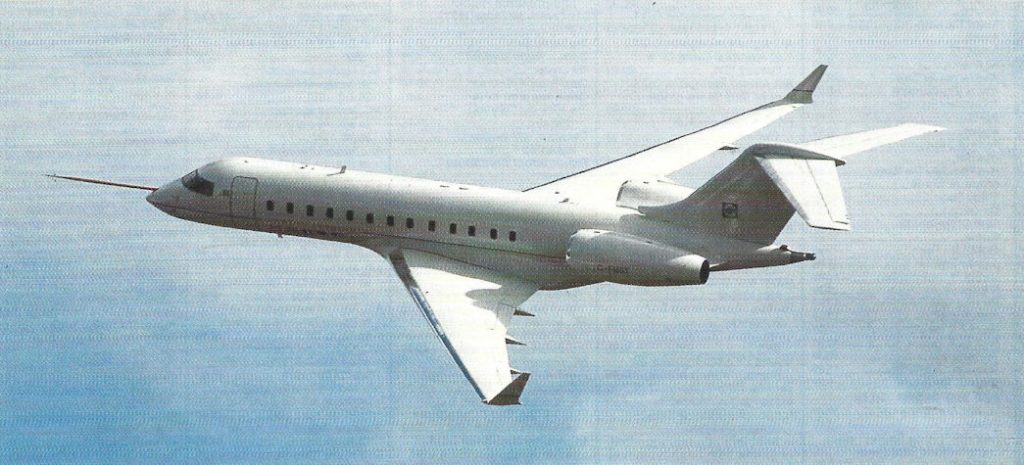
in 1996 I had been working at Bombardier’s Toronto plant (which we called de Havilland due to its heritage as the de Havilland Canada headquarters) for just over a year and and was still in awe of the scale and scope of aviation. A long time fan of aircraft from my childhood watching my dad fly for the military, aircraft captured science, art and romance for me in a way few other things would. And I was lucky enough to be around for the first flight of a clean sheet industry disrupting business jet, the Global Express.
I wasn’t working on it at the time (I was part of the Commercial Aircraft division and working on another new aircraft the Dash 8 Q400 derivative), but I was still very proud to witness this remarkable culmination of thousands of people and dozens of companies efforts to bring this to reality. Even more I could feel the love for this product that was emanating from the colleagues and friends who were working on it, and the utter joy of seeing it take to the air flawlessly. I thought every day would be like this and I’d spend 30 years watching new program after new program take to the skies. I was so wrong.
I’ve been involved in many ‘clean sheet’ aircraft, meaning those that started from nothing other than a sketch and idea. I’ve also been part of tons of derivative aircraft. Derivative aircraft are those that develop from an existing product. For example, a clean sheet would be the Airbus A380(all new shape, design, systems, structures, engines, etc.) , while a derivative is the 737MAX (same 737 shape and structure with new engines, some aerodynamic improvements and structures tweaks).
Any kind of aircraft development can be exciting and beneficial for the company that leads it, but nothing is quite as exciting and risky as a start-from-nothing program where everything is new, and everything needs to come together perfectly to make it all work. Typically companies launch clean sheet aircraft to disrupt the market, or create new markets, and can cause major changes in the way customers use the whole industry. The Learjet defined what a purpose-built private jet is, and created a whole industry. The Boeing 707 made non-stop trans-atlantic flight a reality. The 737 made jet flying accessible to the masses.
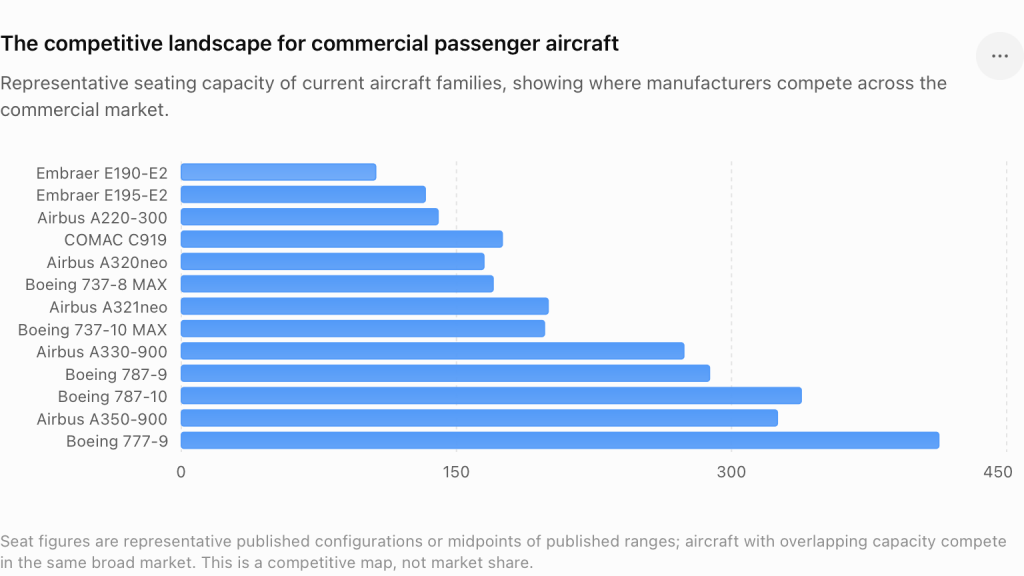
Nowadays there a two big players in commercial aviation, with smaller companies in the regional sector, and a handful of business jet manufacturers. And there has been a lack of true clean-sheet aircraft in recent memory and likely none in the medium-term either. There have been many articles pontificating about this, and citing many industry factors but I think they all miss the main point: there is nothing disruptive to do right now, and the industry is in a very stable reality that doesn’t have major disruption coming anytime soon.
Civil aviation is commoditized
Market landscape in airlines and biz jets
The first reality check is the view on the market. Two things are driving stability, the global economy and competition in every sector that is relatively balanced. It basically means that times are great for the manufacturers and they can be very confident in their sales projections, backlogs, and growth. With that kind of stability, there is little incentive to invest heavily in disruptive products.
Global Economy
The market hasn’t had a correction in a long time. Not since 2008 has the economy taken a real downturn. That’s an extraordinary run, when you think about it. You can argue that the COVD pandemic hit the global economy hard, and it did, but most industry rebounded very quickly and came back even stronger. The pandemic didn’t affect demand for goods and services, it temporarily suppressed it. And as people returned to life and health, the economy jumped right back into action. The supply chain in aerospace took a long time to ramp up, and that hurt deliveries for most manufacturers, but demand was strong right away. Backlogs increased rapidly and now most companies enjoy 4-5 year backlogs on all products.
Healthy but stable competition
Looking backwards, many brand new aircraft types were driven by the need to enter into markets that the company in question weren’t active in. For example, in the business jet sector, The Global Express, the Falcon 10X, the Challenger 300 are all clean sheet aircraft designed to create or enter markets. The markets either existed already or were being served by an inferior product that was ripe for disruption.
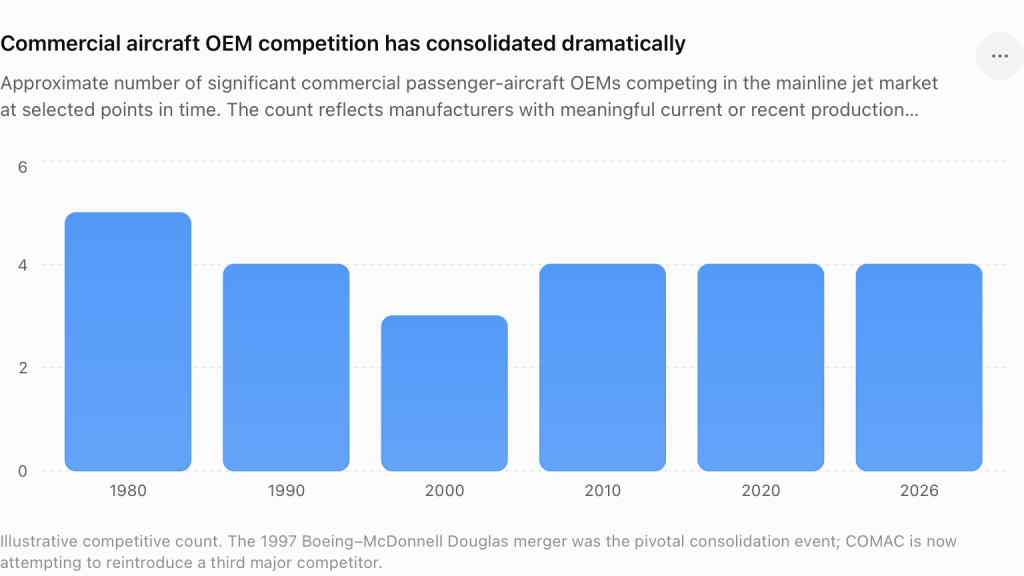
Fast forward 20 years and the market in business aircraft is full. From the very light jets all the way up to the ultra long range, every market has at least to well-performing products for customers to choose, with stable customer bases and reaching the limits of practicality (17 hours non-stop, 51000 ft max altitude and M0.95 maximum speeds). In many sectors the products available are very close in terms of specs and performance. But there aren’t any real gaps in market left for a new entrant to truly disrupt the status quo. So most OEM’s are focused on minor upgrades to reach marginal edges on competition and are comfortable enough to reap the rewards of a strong economy and a stable market.
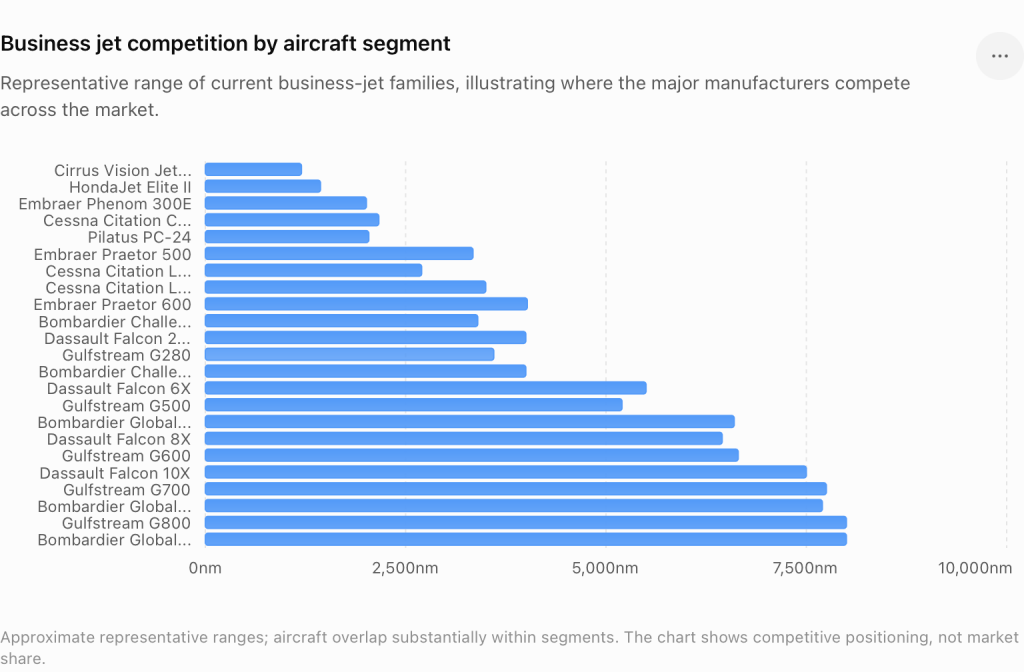
COMAC is attempting to wedge itself into the single-aisle airliner conversation, but no doubt Boeing and Airbus will be aggressive in trying to keep them out, much like they did when Bombardier attempted it with the CSeries.
The excuses
A number of publications have discussed the lack of new products, and have landed on a number of factors. None of them by themselves really reflect what’s going on.
Authorities and crackdowns
With the horrific accidents on Boeing 737MAX and the door blowout incident, the FAA was justifiably destroyed in the media because of a lack of oversight in product development and has been systematically swinging the pendulum in the opposite direction. Manufacturers complain about the sudden strictness from the authorities on oversight, testing, proof. While the FAA has definitely woken up and are being more diligent, to my relief, the other authorities around the world have been consistent in their approach, namely EASA, Transport Canada and CAA. So while this ‘crackdown’ by the FAA is being used by companies as a factor in not developing new aircraft, it’s been the reality for decades that the authorities at large have been systematically updating regulations to improve safety for the public and is a very well understood set of criteria for anyone developing new aircraft.
Cost
The cost of developing a new commercial airliner could be as high as $50B, so you can be sure that Airbus and Boeing want to ensure a return on that massive investment. Even with a complete turnover of the existing fleet (which is impossible), the payback on a new aircraft will be measured in decades. But if there was an untapped market, or disruptive techonology that could dominate and beat competition, manufacturers would jump on the opportunity. Competition is alive, it’s just stabilized to the point where no one new aircraft will be different enough to move the needle on buyers preferences.
I don’t doubt the price tag is daunting for executives, but if there was a real ROIC and a chance to disrupt the competition I think this would not prevent them from launching.
The power in consolidated supply chains
The other issue, somewhat related to cost, is the consolidation of the supply chain in aerospace. Over the last decades, Large Tier 1 suppliers have been scooping up smaller players and reducing the level of competition for aircraft manufacturers. The M&A business cases were generally sound for the companies involved but the consequence was that suppliers became larger than the aircraft manufacturers, and had much more leverage than before in negotiating contracts for new products. So costs have escalated.
It is a factor for sure in the rising costs of developing aircraft, to the point that OEM’s (original equipment manufacturers, or airplane makers) are looking to vertically integrate again to counter the actions from suppliers.
But again, the reality is that innovation is driven by necessity, and if there was a disruptive technology or idea that would upset the market in a significant way, then OEM’s would jump on it and find a financial model that worked.
The real reason: nothing to disrupt
There is nothing immediately available in terms of disruption that motivates any OEM to launch a clean sheet. We saw above that markets are stable, growing with a healthy backlog, and commoditized everywhere.
Sustainability and environmental protection is a conversation in the public domain, but policy-makers and governments are resisting regulations that would drive significant technology changes because of the costs involved in transitioning the ~30,000 commercial aircraft in service today. And the pro-business governments are loathe to jump first into regulating their businesses and put them at risk vs. foreign competition. And electric or hydrogen propulsion systems are likely decades away from being practical for large-scale and long-range use.
Supersonic aircraft are continuing to be in the conversation, but sonic boom regulations, and the significant negative view of the massive fuel burn it requires are likely to keep these aircraft as concepts only for the foreseeable future.
Military developments sometimes leak into the commercial space as disruptors, but the most significant developments are in drones, autonomous vehicles and attritable aircraft (one-way trips) and will not result in any major new aircraft development in the large aircraft sectors.
It is notable that aircraft are rarely replaced by the manufacturer themselves with a clean-sheet aircraft. The reason is that the airframe aerodynamically is usually very well optimized for its mission, and so the life of an aircraft can often be extended with new engines, systems, and interiors to keep them competitive, at a much more lower cost.
So until someone invents transparent aluminum or a hyperdrive, it’s unlikely we will see a new clean sheet anytime soon.

