


A common paradox
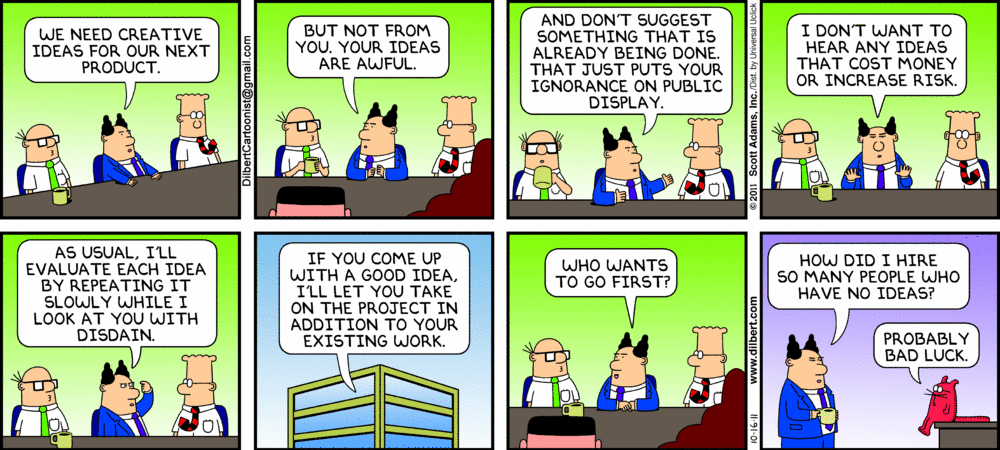
Leaders of large, established organizations typically ask their subordinates to be both predictable and creative simultaneously. They want to grow and reduce costs, innovate on processes and products without disrupting their established businesses and execution. On the surface, that sounds reasonable. We want to protect the stability of the business and find better ways to do things. We’d love our people to experiment with new ideas without upsetting the predictable results that we count on for profits and survival.
In reality, the tension creates a system that does neither particularly well unless boundaries are upheld rigorously. Predictability is based on reducing variation and change in the system. Change is the enemy of reliability. Meanwhile, creativity only comes from change. Experimentation can be messy and will fail before it succeeds. New features can be more predictable and reliable, but only if proven first.
Most often, leaders use the buzzwords of creativity, empowerment and innovation, but the machine of predictability ensures that none of those things survive in any meaningful capacity. Strategic projects stall, delay or underperform. New ideas are cancelled before they are tested to avoid anticipated risk-taking.
Leaders like this are often frustrated with the low quality of new ideas, the poor pace of change, and the lack of focus on strategic initiatives. They may blame the leaders in these areas for their failure to be predictable and creative.
Imagine hearing a leader telling a team:
“I want you to experiment, challenge conventional thinking and come up with something completely new—but don’t make mistakes, don’t miss your deadlines, don’t disrupt the existing process and make sure the results are predictable.”
Have you heard something like that yourself? That isn’t a culture of innovation. It’s a culture of innovation theatre. People will become skilled at appearing innovative without actually being novel. Or they will present novel ideas to appear innovative, fully expecting that the organization will kill them before they have to take any risks.
In my aerospace experience, this is even more pronounced. A manufacturer cannot casually experiment with an aircraft that will carry passengers tomorrow. Reliability, certification, manufacturing consistency and operational safety are non-negotiable. The industry has therefore developed extraordinary capabilities for controlling variation. That culture, however, has created a convenient excuse to stifle innovation.
If this is your organization, then your team hasn’t failed. You have failed to avoid one of the most common mistakes in leading: Clarity.
A time and a place for everything
The problem isn’t that you can’t have both. It’s that you can’t have both at the same time on the same product. The solution is knowing when and where to apply each, and having a mechanism to transition smoothly between modes. What kind of mechanisms are out there?
Incubators
Many large companies have adopted this strategy very successfully. In consumer electronics, most companies have innovation labs that experiment with new technology, ideas, features, materials and manufacturing to stay ahead of the competition. Apple has their Apple 2 “Spaceship” building where its advanced R&D and industrial design are housed. Every automaker in the world has a design centre that creates the next models in total secrecy and builds everything from digital, clay and fully-functional prototypes before committing to engineering and production.
DARPA and Skunkworks are two famous examples of incubators that can take risks in the normally conservative aviation industry, proving that the model works even for the most heavily regulated and slow-moving businesses.
Experimentation and risk-taking are the norm in these places, and the pace of innovation is inspiring. Eventually, these ideas have to materialize into a predictable production environment. Most of these organizations use a systematic cadence of deployment, that is yearly models in automotive and technology, and software updates periodically to existing consumer devices. The advantage is that only properly tested and vetted ideas pass through, and it lines up with yearly financials.
The Toyota Way
In 1949, Toyota implemented statistical quality control into its production line. Two years later, they introduced a “Creative Idea Suggestion” system to capture inputs from the entire workforce. By 1995, they had 30 million suggestions.
Toyota implemented a brilliant system into its day-to-day processes and revolutionized manufacturing quality. A “micro-innovation” methodology was created, refined and embedded over 60 years, and drove Toyota to be the largest auto company by 2008. I’d argue their creativity in design is lagging some others, but their attention to detail, and continuous improvement culture has made them the highest-quality, most reliable autos on the road, and buyers flocked to them.
The micro-innovation model works because Toyota’s culture is to work hard at these suggestions and spend energy outside of production to design, test, and prove the solutions before reintroducing them into the main lines. They still separate the predictability from the creativity.
The methodology was so successful it spawned a whole industry of people attempting to learn and copy it elsewhere.
The main reason that it didn’t achieve the kind of revolution that happened with Toyota is that the underlying culture there is built over decades. And it constantly reinforces and encourages creativity to solve problems. They reward the behaviour, instead of measuring savings or benefits immediately, which is what I’ve seen in other places.The 15% Culture
In 1948, William McKnight instituted what became known as the 15% rule: all employees can and do take up to 15% of their working time and using company resources, work on projects that they want to, to solve problems, explore ideas, and make mistakes. In other words, innovate. It started with his mantra of “Listen to anybody with an idea”. This kind of openness has led to incredible growth; during his tenure from 1914 to 1966, 3M achieved a CAGR of 17% – over 50 years!
“Management that is destructively critical when mistakes are made kills initiative. And it’s essential that we have many people with initiative if we are to continue to grow.”
– William L. McKnight, Former President (1929–1949)and Chairman of the Board (1949–1966), 3M
The methodology was unique but the core strategy is the same as in the other examples: separate the time and space where creativity can reside from the rigour and discipline required to execute dependably.
Creativity creates the future. Reliability protects the present.
In all of the examples above, it is never about being creative or reliable as a choice. Both need to exist to ensure the stability and growth of any organization. If a company only focuses on reliability, eventually it will not be competitive in the market or agile enough to change when disruption happens. If a company only prioritizes creativity, then it won’t survive because nothing gets delivered.
Effective leaders create the culture and structure where both exist, at the right time and in the right proportions. There are many ways to accomplish this; a lot depends on your type of industry, the relative costs of experimentation, the capability of senior leaders to switch between these two modes of thinking and operating and the pace of change in your market.
If your senior team is built around reliability and execution, then they may not be able or willing to trust the often uncertain and messy environment in the creative phases. Think about the ttypes of questions that must be asked in the two extremes.
During exploration, leaders need to ask:
- What haven’t we tried?
- What assumptions might be wrong?
- What would we attempt if failure were inexpensive?
- What experiments could teach us something?
- How quickly can we learn?
During exploitation, the questions change:
- How do we make this repeatable?
- How do we eliminate variation?
- How do we reduce defects?
- How do we scale it?
- How do we make the result predictable?
A common mistake that leaders make is applying the second set of questions to the first phase of exploration. Asking for a Return on Investment when an idea is just a drawing or a crude prototype ensures that the idea will die. Never judge prototypes as if they were finished products. The best organizations understand this distinction intuitively. They create spaces where experimentation is protected from the full weight of operational expectations.
Conversely, once an idea succeeds in the experimentation phase, the execution has to be reliable and even boring. It’s equally important to be able to tell the creative minds to stop when something is good enough to implement. Perfection is the enemy of getting things done. You don’t want to be changing the design two weeks before delivery.
This may be the most important role of leadership in an innovative organization: knowing which parts of the business should be boring and which parts should be allowed to be messy.
The factory should be boring. The certification process should be boring. The financial reporting process should be boring.
That 15% of the company that is creating the next disruptive product? They must be allowed to make a mess every once in a while.
The paradox is an illusion created by leadership
The paradox disappears when we stop asking the entire organization to be both reliable and creative at the same time. Instead, build systems and a culture where creativity produces possibilities and reliability turns the best possibilities into reality.

