



The (non) value of management
I needed a job to help pay for university. I loved hanging around in bars (as any good engineering student would say), and thought, “hey I can bartend”. The local college had a course for $300 and in 40 hours over 10 weeks you learn mixology, everything from distillation theory and wine tasting to free pouring and all the exotic recipes you could think of. Going into the class one night, I noticed next door people walking in, looking 10 times more professional than the tattooed and grungy lot that I was with. Peeking in I saw on the whiteboard “Management Training for aspiring leaders”. Management training? Pfft. Not interested. I was a young and nerdy engineer at the time (as opposed to an old and nerdy engineer today), and wasn’t interested in managing people. I loved the science.
Still, after my class I went online and checked it out, just from curiosity. For $500 and 18 hours you can earn a certificate in management! So easy. Less than half the time it took me to become a bartender I would have all the skills I need to manage people. Or so I thought, naively. Little did I know just how much I didn’t know about leading people.
Management isn’t just about getting shit done.
Spending so much of my career in aerospace, I saw so many people who are technical experts rise to take on first-line management positions. I was one myself, moving from aerodynamics to managing a team of interior engineers. Aircraft engineering is a very technical field, and it’s expected that anyone leading highly-trained engineers know what those people do. Knowing how to help those people do their jobs, knowing how long each task should take, and how to resolve technical issues are all the primary responsibilities we place on those first level managers.
However, for most organizations that’s where the expectations stop. For a few other companies, they also send their new managers to those college adult education courses to get the basics on managing performance, giving difficult feedback, and time management. But all of them fail to recognize one important truth: managing people is a completely different job and career than what those new leaders did before.
And then we wonder why there are so many ‘horrible bosses’
I believe that people are fundamentally good and that everyone comes to work to do their best. Then why do so many managers do horrible things at work to others? Popular culture glorifies the “tough” boss, the take-no-prisoner kind of person that has everyone in line and driving them hard to deliver. I think when people elevate into leadership positions their first instinct to project toughness, because they themselves are insecure about doing a good job.
In a research paper about the lessons in first-time leadership in the military, many of the participants who were interviewed commented on how insecure they felt, comparing themselves to senior officers, and knowing their group so well, feeling inadequate to lead them. So they work at projecting competence even when they don’t feel it. They employ the “Fake it till you make it” methodology. But often new managers will come across as overbearing and insulting, in order to soothe their own feelings of self-doubt.
In other cases, they will try to go the other way and be very lenient, friendly and try to remain one of the gang. This also fails obviously, because the team won’t respect them and performance suffers.
And the third issue is expectations from upper management. There is pressure from above to deliver. And it’s almost the only measure that matters in most companies. So the focus naturally goes back to getting shit done. I am the first person to say that results matter, more than just about anything, but there are millions of ways to achieve results and it has been shown through endless studies and surveys that through effective and engaging leadership you achieve the best overall results, far beyond the dictatorial approach.
Therefore, leadership training is vital to helping our highly technical people become excellent leaders and yet the most we do is send them for a few hours in a night course that is less time than bartending school.
MBA programs aren’t the answer either
A Masters of Business Administration is the current standard education for business leaders of the future. Curriculums typically include heavy subjects like Financial Accounting, Marketing, Strategy, Operations and Supply Chain Management, Organizational Behaviour, Entrepreneurship, and many do have modules on leadership. But it’s one course, and most of them focus on self-reflection on students styles, behaviours, strengths and weaknesses. Harvard has an interesting program that actually recognizes the need for having a vision, enrolling people in that vision, understand corporate culture and its impact.
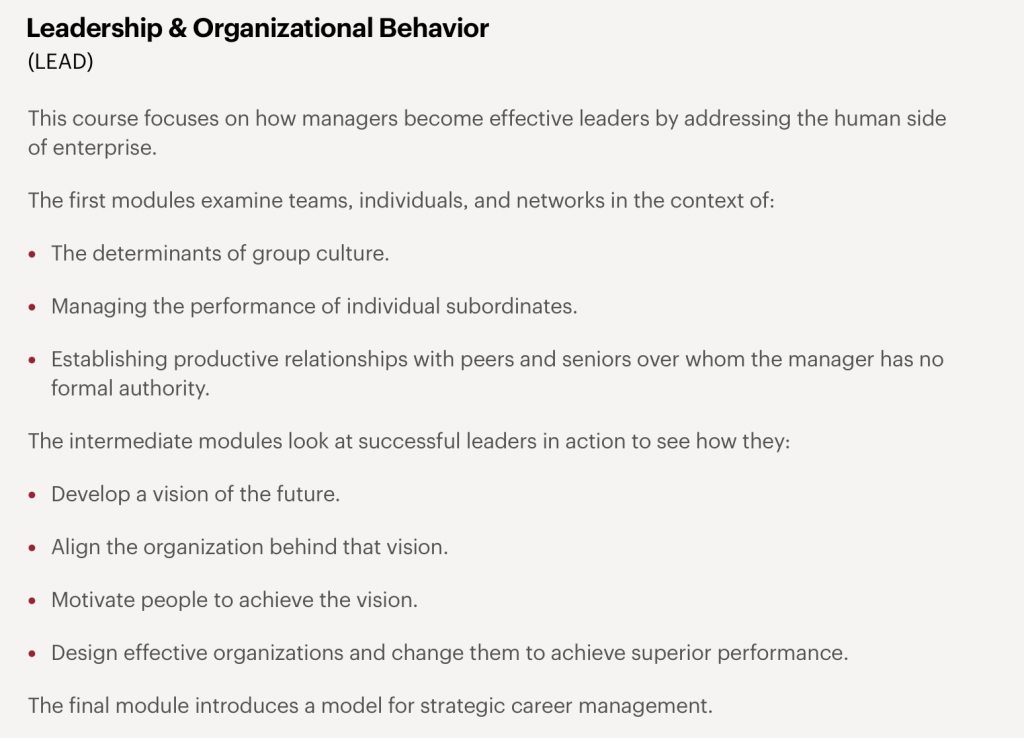
But most 2 year MBA programs fall woefully short in terms of the impact and value of understanding human psychology, connecting with your people in a meaningful way, and creating a culture that performs above the norms in industry today. Learning how to master things like communicating, deep listening, fostering trust, being accountable and taking responsibility are critical to great leadership.
Rallying to deeper learning for better results
Like anything worth doing, people are going to generally suck at managing when they start. Investing in learning the behavioural skills that are the primary functions of all leaders is essential in high performing organizations. It can take time to become comfortable in this brand new career path, and even more to be confident in your leadership abilities, but the payoff to the individual and to the people they lead is immeasurable.
At Platypus, our Leading from Within program is an intensive exercise in mastering all the behaviours that allow leaders to excel. Contact us to learn more. I’m interested to know your experience with front-line managers and how they perform.

