


Why has performing become “looking good” instead of “being good”?
Opinions are like assholes, everyone has got one. I love the expression, but it’s often used in the context of someone having an unwelcome or ‘useless’ opinion. We say it about someone who only wants to complain and therefore should be ignored. People tell me that I have lot’s of opinions. And that I’m an asshole. Sometimes I’m sure I am. But I know most of the time, when I do have an opinion it’s because I care about what’s happening, and I want to see the best solution possible. And as leaders one the most important behaviours to protect and grow is the ability for anyone in the company to speak their mind.
In a world where social media influencers are shoving their ‘best life’ in our faces, and we celebrate people who have ‘figured it out’, and on the flip side if someone says a hot take on a subject is forever banned from life through endless trolling online, why would anyone be themselves in any situation? In corporate life it has been like this for a long time: it’s survival. Follow the ‘party line’ of what leadership believes or be ostracized. I understand why it’s like this, when someone has the power over such an important part of your life (i.e., your income), then of course there’s a natural suppression of dissent or even debate. And if it doesn’t feel completely safe to speak up, then it won’t happen.
But I do believe it’s gotten worse. There’s a weird dynamic in large corporations that are generally stable, where at the top of the hierarchy leaders believe there is large amounts of candor and honesty, and everyone is aligned. But from the working-level looking up, people see it’s the opposite. People may be labelled as disruptive, so no one feels safe to say what they really think. Have you noticed though if you can get those same people over a beer (and they don’t think it will get back to their boss), employees will tell you the truth. that To succeed in corporate life it’s more about being performative than performing. As long as you’re convincing to management that you’ve got it all under control then your job is safe. Do you see though how dangerous that behaviour can be if not corrected?
Change is inevitable and messy, so why do we pretend we can do it perfectly?

I think it’s very interesting to see a company’s relationship to change. Change is inevitable, like death and taxes. But how ready and engaged is your company to deal with any change that comes? Do they resist, rationalize it as not important or prioritize stability? Is the change management organization specifically designed to limit and control change to be as little as possible? Opinions and dissent are often seen in the same way as external change: toxic. Successful companies will become victims of their own success and prioritize stability and control over the agility, creativity, and teamwork that brought them success in the first place. Leaders who get too comfortable with their own success begin to see all change as threats, instead of the challenge and opportunities that brought them to where they are.
So even when new products, problems or changes are presented in organizations like this, they have to be bubble-wrapped in a blanket of “Risk mitigations”, and “contingencies”, and “buffers” so that it feels like stability. But who does that in real life when dealing with change, growth or learning? You can’t become a great engineer without first drawing some really crappy versions of airplanes as a 5 year old. Or learn a new language without sucking at it for a long time. And you can’t make a great movie, without the story going to weird places at first like zombie serial killers. See this quote from Ed Catmull, Pixar co-founder, about a movie that eventually became “Bolt”.
A key moment in this evolution came in the fall of 2006, nine months after the merger, at a Story Trust meeting in Burbank. It happened after a fairly awful screening of American Dog, a film structured around a famous and pampered canine actor (think Rin Tin Tin) who believed that he was the superhero character he played on TV. When he found himself stranded in the desert, he had to face for the first time how his tidy, scripted life had not prepared him for reality—that he, in fact, had no special powers. That was all well and good, but somewhere along the way, the plot had also come to include a radioactive, cookie-selling Girl Scout zombie serial killer. I’m all for quirky ideas, but this one had metastasized.
Catmull, Ed; Wallace, Amy. Creativity, Inc. (The Expanded Edition): Overcoming the Unseen Forces That Stand in the Way of True Inspiration (pp. 328-329). (Function). Kindle Edition.
And yet in large and stable organizations we expect people to be perfect when doing something new, such as dealing with a product change in an organization. Thy can never miss a date, a budget or a quality target. Their design solution has to be perfect right out of the gate, can never iterate or change along the way. It’s an impossible request and yet so common.
The Frantic Duck
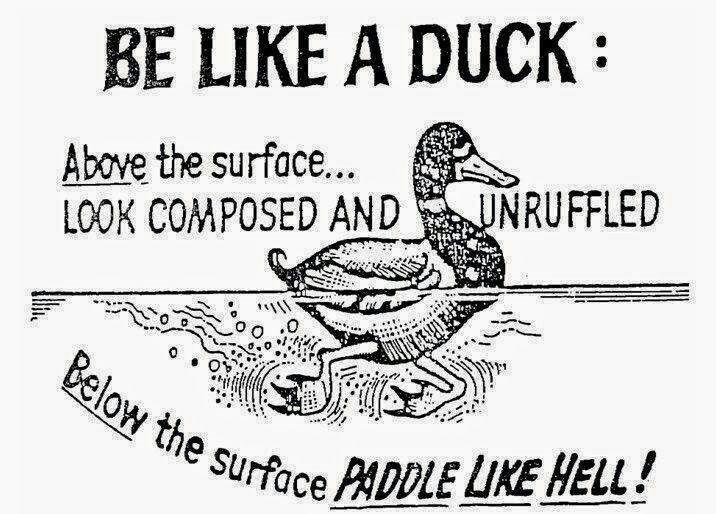
I was sitting in a governance review, one of those painful “dry-runs” for the presentation to senior management. The VP in the room (who was going to give the presentation to his bosses) was running the meeting, scrutinizing every comma, every colour-code on a chart and the tone of every statement. His goal was simple. I understand to a point what was happening, if you’re in charge of a project you want to make sure you’re on top of everything. But this was manic. He was yelling and screaming at his team who prepared it, calling people in and throwing them out, barking orders and audibly sighing and rolling his eyes when shit wasn’t done exactly like he imagined. He knew the problems the project was having, he knew we didn’t have answer for everything, but he also knew it wasn’t ok to be transparent about it.
I knew it too, it was the game you played in the culture we both operated in. I went to his presentation, and everything went smoothly, and of course he appeared completely in control of everything, reassuring leadership all was fine. And then later on we had to reset the program by years.
This is what being performative does to enterprises, it removes the transparency that enables honest conversations about issues. It defers problems until they are too big to save. And your employees see it, and see that real conversations aren’t acceptable. It creates a cultural tradition of masking problems. Even what your team is telling you is suspect. Not out of maliciousness, but they actually believe you’re not supposed to.
Don’t be like a duck.
A healthier and harder choice
There is a time for rigorous adherence to a plan. When all the of the unknowns have been tackled, and it’s a straight shot to execute and deliver then the team should be in execution mode, minimizing changes. But that’s only after the designs are done, supplier contracts are signed, testing and iteration is complete, and production is up and running.
Before all that is complete, leadership should be continuously looking for issues, problems, concerns and knocking them off. That requires transparency at all levels. And it will be messy. There will be big problems and little problems. There will be conflicts. Isn’t that what leaders are there for? Encouraging candor, that ultimate level of uncomfortable honesty about what is working and what isn’t is so important in doing any endeavour that is complex; which is almost everything these days.
How do you do it?
- Start by modelling it yourself. Say “I don’t know how We’re going to do that”. Talk about what doesn’t feel right to you. Thank people who are brutally honest about what they see. Ask for more information about their concerns so you can understand it fully.
- Ask if people feel comfortable being honest, and if they say yes, ask again. They may not be comfortable being honest about being honest! it’s ok, it’ll take time for people to trust that its safe.
- Do anonymous surveys to check the culture that exists, if you’re not sure that it’s safe for everyone.
- If you can’t be this way with your boss, tell your team that you will be with them, and explain how you can’t always do that presenting upward. Try to create a bubble of safety within your team.
- Allow your team to iterate on issues, and engage in discussion about them, without criticizing that they are making mistakes or taking longer than you’d like. Trust that they are trying to do their very best.
Like I said, it’s not easy but it pays off in the long run. You will save money and complete projects faster, guaranteed.

