


What’s the Problem?
In 2010, I was asked to lead the development of the next generation of interiors on a brand new aircraft platform, the Global 7000. Meant to be the largest, fastest and longest range business jet ever made, it was an enormous responsibility and I was excited to dive in. We had a lot of experience on designing, certifying and building interiors having delivered hundreds of smaller business jets. So what should the interior look like? Would it be cutting edge, or mainstream? Would it use new materials, manufacturing techniques, and technologies, or stay true to the existing products of the day, assuring a low-risk approach? At first blush it would seem a good decision to stay with what is known, given the size of the project.
I wanted to take a different approach. Before this program launched, I was responsible for the customer interactions, engineering and certification of all the customized and specific interiors for the Global Expresses. It was a very unique and special position, in that it was highly technical and creative at the same time. Someone who can afford to own a business jet or buy one for their company has very little knowledge of how difficult it actually is to make one of these things fly safely AND deliver on all the luxury, amenities, and desires of the client. They want to be creative and put their own ‘signature’ on the aircraft, in decor, technology and materials. And rightly so, they are putting a significant amount of money down on one of these gems.
But I started to see a problem emerging from my countless interactions with the high net-worth individuals. No one was really listening to them. What I mean by that is no one was taking the time to deeply understand their perspective. Most people charged with satisfying their needs would spend a lot of time telling them why what they wanted “wasn’t possible” or was “cost-prohibitive”. Or customers would have an issue with the low-quality of a particular part of the interior, and the answer would be something along the lines of “we have to make it like that for cost, weight and certification”. In other words, we had created a paradigm around how luxury aircraft would look and feel based on the constraints imposed at the beginning of the process.
I took it upon myself to really lean into listening to these people and trying to understand their perspective fully and not defend anything we were doing. Just listen. And imagine myself in their shoes, and ask what would i want if I was in their place? Ad it started to dawn on me that we didn’t design for the customer, we designed for the constraints. And it showed. Whether it was seats that rattled too much, exterior paint quality disconnects, or entertainment and connectivity technology that was three generations behind the latest home systems, we weren’t living up to the reputation of a luxury product. To be fair no one in the industry was either; this was the norm in business aircraft at the time, and no one saw the problem. If the competition was worse than us, then why change, right?
I saw that was a problem and it could be solved. I started to learn as much as I could about great design, and how some companies were able to produce things that people absolutely loved and be profitable. And I thought if we could really focus on creating products that people will connect with emotionally and completely then we could create a disruption in the market that would boost our growth and profitability at the same time. So I made that the core problem that we would solve on the next generation aircraft, and it worked. We created a new standard that wowed people and made everyone else try and copy.
And now whenever someone asks me how we did it, and how they can make their companies more innovative, the first thing I try to understand with them is what problem are they trying to solve. Because great ideas don’t just pop into your head from nothingness. Being clear on the problem gets everyone aligned on looking for answers.
So ask yourself, why do you want to be more innovative? Is it because of some feedback that your clients or customers have told you? Is it because you are losing market share to a new or better competitor and feel like you need to do something new but don’t know what? Or is it because the old ways of doing things that used to work don’t anymore, or they’re too expensive or risky? Once you know the answer to that question you can start to dig into what the specific goal needs to be. Say, for example that you need to find a way to take 20% out of your costs to stay profitable. How are you going to get there? Oftentimes the impulse is to use tried-and-true methods, like layoffs, cost-cutting ‘initiatives’ or a collection of process or technology improvements that a consultant would recommend. The real answer lies more in the culture that you’ve created than the specific initiatives.
No one bats 1,000
In baseball, “batting 1,000” never happens, not even close. By the way, if you’re not into baseball, they rate batting average as a percentage, but say it in decimals. It’s weird, I know. so if you hit 50% of the time, your batting average would be 0.500. “Batting 1,000” would actually look like 1.000 or 100% of the time. The expression has come from the reality that swinging a tiny bat at a baseball traveling at almost 100 mph from a distance of 60 feet and 6 inches away is nearly impossible. It takes about 0.4 seconds for a ball to cross the plate after it’s left the pitcher’s hand and the batter has about 0.1 seconds to decide to swing or not, and also whether its a fastball, curve, slider, splitfinger, change-up or slurve. The best baseball hitters in the world in the major leagues hit on average about 25% of the time they’re at the plate. And that’s seeing on average 4 pitches per at bat so the percentage of making contact and getting a hit is even lower. Who in our jobs today would be ok doing the right thing 25% of the time? Or would even keep their jobs at that rate?
Baseball is a great analogy for life. It’s a team sport, when defending relies on great coordination and team play to make outs and yet also relies on great individual efforts in batting, pitching and fielding to succeed. Errors are made. And perseverance is the key to success in innovation, not giving up no matter how unsuccessful we are at trying to hit the damn ball. Intuitively, we all know that as humans we are not and can never be perfect, and that mistakes are a normal part of life. And yet in our professional lives a standard of perfection is quickly demanded of most of us.
That fear of mistakes or obsession with perfection is very pervasive in our society and one of the most toxic beliefs that leads to companies losing their edge in innovation and creativity. Trying and failing at something, learning and growing, and then trying again, is the foundation of practically all innovative pursuits. Of course, not everything can operate like this all the time in corporations. When you are in a production run of something you want to minimize the creativity and innovation and focus on repeatability. But anytime you set out to “solve a problem”, there needs to be some room and some psychological safety for your people to take some swings and misses.
Creating that room for experimentation is both structural and cultural. You would never change a tire on your car while driving down the highway at 100 kph. You need both the garage and the highway. So step one is to create an environment and organization that is allowed to experiment, away from the performing, money-generating part of the company. You can’t effectively do both at the same time with the same people. Not only do you risk the day-to-day activities that are the life-blood of your company but you will frustrate the creative side too, because they will inevitably be pulled into the panics and crises of the normal business. The other thing about the structure is funding and expectations about the spending. There has to be some room for failures in spending too, meaning some of the things the innovation team will try won’t work. And this can’t be viewed as a failure in spending or lack of Return-on-Investment as a whole. Part of being more innovative is that your overall business will be better off financially for it, but analyzing each project as a financial success or failure is a no-win scenario. It’s a far better strategy to build the system for innovation and measure success as a whole, that is how successful it is at bringing things to market that maintain or create an edge over competition.
The second and more difficult task is to create the right culture. Culture is a funny word and often seen as a ‘soft’ requirement in corporations. But there are very important and challenging leadership behaviours that will help foster innovation in the organization as a whole. Ed Catmull, one of the founders of Pixar and author of Creativity, Inc., is a fantastic hands-on leader of the innovative process there. In his book, he talks about his endless pursuit of protecting the ‘magic’ process of creating some of the most beloved characters and stories in animation. It is a grat lesson in how you can be innovative in a technical company as well.
A Victim of their own success
Toy Story was released in 1995 and was the highest-grossing Thanksgiving release of all time. And you could point at the unprecedented animation quality as the draw, but Pixar’s real key to success was the impeccable storytelling. We all cared about Buzz, Woody and Andy and the relationship they had with each other. And it was no accident that the storytelling was so good; it was never their intention for it simply to be a showcase of technology. It was first and foremost meant to be a great movie and the story was the only thing they would never cut corners on. And underlying all of that was a culture that allowed anyone to speak up, and say something about the story that didn’t work. And allowed a ton of iteration in imagery and story before aligning internally on the final product. It has massive parallels to the innovation process that works in forward-thinking companies today. They created meetings called “notes meetings” where anyone on the project could provide feedback to the director on the movie, on any topic, including how the story was going. It was an incredible example of a concept called Psychological Safety, or an environment where employees, no matter their level in hierarchy, could contribute to and disagree with anyone about the project. It was an intentionally created culture that allowed a large team to iterate, collaborate, debate and disagree with each other in a very constructive way. Sometimes, they admitted, it was hard to hear the feedback. But over time everyone got used to it and accepted that it was a great way to be innovative and get the very best of their movies.
But as Pixar grew and were working on multiple projects simultaneously, and created a large organizational structure, they started to notice a shift. People started to hold back more. The organization got so big that it was hard to maintain this openness. Some people who were hired into the company saw the leaders, Ed and John Lassiter especially, like gods. They revered their success so much that newbies became intimidated by them. It was a lesson for Ed Catmull, as he so eloquently described in his book, to never be complacent with how people feel about speaking up, bringing new ideas and being creative in their work. And so he went a step farther and created a full day where everyone in the company would work in groups on anything they felt needed fixing at Pixar, including the culture. They returned to their culture of safety.
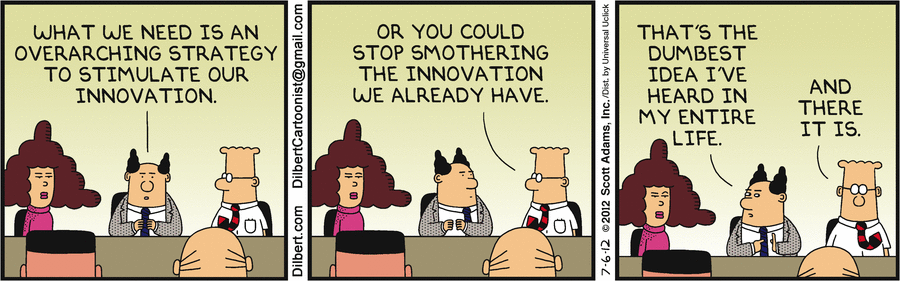
Ed was focused on making Pixar the best culture it could be, but he came to realize that it’s probable like this in any large company. And he’s right. When we have success in an organization, the impulse in leaders is to stick to what just worked, and keep going. But what many leaders don’t see is that by favoring controls and systems that won’t change, it is subconsciously signalling to the entire company that change is bad. Ideas are bad. Innovation is bad.
This is what I mean about creating the right culture. Oftentimes, companies that struggle to being innovative have a bigger cultural problem within, one that may be invisible to most leaders. Because on the surface they believe they are having candid conversations with their teams or peers, but in reality everyone is holding back something. Because maybe subconsciously you as a leader are rewarding and recognizing the people who avoid risks, or deliver on time all the time, or exhibit behaviors that show making mistakes isn’t tolerated. And so people within the organization learn that trying and failing something is discouraged, or highlighting a problem or an unpopular but true fact is alienating. Almost certainly, these cultural problems are present whenever you are thinking your organization struggles to be innovative.
Trust the people and the process
The last thing is to trust. Trust that the people involved are talented, care about the company and its success and will try to innovate with the best intentions. And let the process work. That means let them try and fail, and learn and iterate. And repeat. There needs to be a goal with deadline for sure, otherwise creative people will iterate forever, so make sure that you set a cadence for when some kind of innovation needs to come out the other end of the black box of creativity. But within the process, let the experimentation be. Even better, reward and recognize the failures as learning opportunities. Give people support for big swings, and reassure them that it’s ok. Because eventually they will pay off. It can be difficult for leaders to behave differently when interacting with the team, because the old impulses of eliminating mistakes, and making things operational and repeatable will trigger. But leading innovation requires a different set of communication skills. You need to demonstrate that you trust their intentions and abilities despite the inevitable failures that will happen along the way. Persevere. It will pay off.
Putting it all together
Recapping it all, remember these tenets to creating an innovative organization:
- Identify the problem that you want to solve with an innovative approach
- Create the organization that will innovate, separate from your day-to-day executing organization
- Be relentless with a culture that has safety to experiment and iterate without fear of consequences
- Trust the people and the process

